About Me

- Homestead Roots
- My tremendously supportive husband & I have 3 wonderful children, 1 dog, 12 laying hens, 2 dairy goats, 3 bee hives, and a 2000 sq foot vegetable garden on a small 1/4 acre lot in the city. In the center of it all is our small 1,000 sq foot house purchased in 2008 as a foreclosure that we fully renovated to host our growing family, home school adventures, and small home business (CozyLeaf.com). We have a desire to learn a path to self sufficiency finding ways to be good stewards of the resources God has given us. We want to learn to live with less as we laydown roots to our little homestead.
Showing posts with label bee hives. Show all posts
Showing posts with label bee hives. Show all posts
Monday, April 29, 2013


Thursday, August 30, 2012
Backyard Areas, How we make it all fit
I have no idea how I have been blogging about our backyard adventures for several years and didnt have a single overall picture to share! So here it is! The summer heat took its toll on our attempt at grass growing, but we will reseed in the fall and hopefully get a full lush lawn by next year!
We have our yard divided into 4 sections. The garden area which is also where the bee houses reside, the chicken and compost area, the goat area and then the yard and play area.

You will have to click on the pictures and make them larger so you can see the labels.

In the far back corner of the yard we have the chicken coop and hen area. It is connected to the compost area so they can constantly be turning and working the compost pile. When we put all the hay from the goat area back there, those girls will work for days getting every last bug, weed, and seed out. They also get any and all food and garden scraps as well as a generous (thanks to Addie) supply of veggies, bugs, worms, and feed. This area is also right next to the garden so we open up and connect the two areas during the winter so the chickens can get out any and all weeds and bugs. Occasionally we do let the chickens and goat all out of their areas (under supervision) for a "walk about" through the yard and garden. The goats sure can tear out some weeds in the garden real quick and the chickens have at the bugs! But if they arent watched closely every single tomato will be gone quite quickly! In between the chicken and goat houses is the garage. The goat house is small and low to the ground (since they are little mini goats). The goats have quite a bit of space and in the middle of their run is the milking barn. This is where all the feed, hay, and any animal supplies are stored.


Here you can see the playset which is almost always in use! The path leads to the garden which is also where the beehives are located. We want them close to the garden for easy pollination but also it provides a protective fence so no kids stumble upon them and get too curious.


 And when the camera is out of course I have to take a few pictures of these little cuties!
 And these two crazy and overly energetic cuties!
I would like to add that our animals do have more attention and interaction than most others. There is almost always someone in our backyard playing or working and we are playing, feeding or grooming them constantly. The animals are not continually restricted to confined areas. They are regularly patrolling the entire area finding snacks or playing. We have found it is safer for the animals and for our children and their friends if everyone has their own separate area to retreat to and feel safe when things get a little crazy. And when we have people over we have found it to be nice and necessary for the kids to be able to play and the goat & chickens to go off to a safe and comfortable are to eat or sleep undisturbed.
There you have it! That is how we make it all fit!!
Sunday, May 6, 2012
Hive Entrance of a Swarm colony transfer Top Bar Hive
This is a very strong colony of bees that was brought in from one of our swarm traps. They were transferred into the Top Bar Hive a few minutes before this video was taken. They are adjusting very nicely to their new home and quickly learn the "ins and outs" to their new location.
Bee Swarm Caught using a bait hive Video of the Transfer
 Transferring a colony of bees from a swarm trap into a Kenyan Top Bar Hive. Inside the bait hive, we put a small super frame with old black brood comb and the bees absolutely loved it! As you can see in the opening picture, the black comb was a huge hit with the swarm! We also used lemon grass oil to bait them.


Thursday, May 3, 2012
Bryan Caught a Swarm with his Top Bar Hive Bee Swarm Trap!!

 Bryan has been so excited to try and catch a swarm this year to add to our back yard. Basically a swarm trap is built to lure in bees who are trying to find a new home for their colony.
  And here it is! These sneeky little bees decided not to go inside the trap but to congragate on the outside of the trap and start building their new home there.
  This is all the closer I decided to go...eventhough "they say" that bees will not sting when they are swarming. Ummm, ill just take my chances from a safe distance with a good zoom!
 Under normal circumstances the bees would go inside the box and then Bryan could have just sealed up the entrance, unscrewed the box from the tree, and brought the whole thing home. But in this situation the bees were all on the bottom so he had to get another box to drop the bees into so he could bring them home that way.
 Get ready... Give the box a good thump or two...they all fell into the lower box...
 Make sure they are there...Close the lid and we are off!
 By the time we got home it was getting quite dark so I only got one good picture. All he really did at this point was to open the box and dump them into the top bar hive! And by morning they were off and foraging!
Wednesday, May 2, 2012
Queen Bee Piping!! Videos of our new Queen Piping!
First, I would like to say that I am quite gullible! I will believe pretty much anything Bryan tells me, so of course YES he does trick me sometimes and YES I do believe him! We ordered a queen bee for one of our colonies. Bryan put her into the top bar hive and what happened next brought on quite an interesting dialogue!
Dialogue as follows...
Bryan: "Our new queen is Piping"
Abby: "Ok....wait, What!?"
Bryan: "Virgin Queen bees will make a noise (insert his impersonation of the noise here) when they enter a new colony and its called Piping".
Abby: (laughing, thinking this is really a stretch for him to make this up!) "WHAAAT!?!? Are you messing with me? Cause I really thing you are messing with me!?"
Bryan: "No Im serious. Shes doing it right now!"
Abby: "WHAAAT!" (while running for the camera!)
Ok folks...As if bees could be any more amazing, they go off and do something like this!!
Piping: "Piping describes a noise made by virgin and mated queen bees during certain times of the virgin queens' development. Fully developed virgin queens communicate through vibratory signals: "quacking" from virgin queens in their queen cells and "tooting" from queens free in the colony, collectively known as piping. A virgin queen may frequently pipe before she emerges from her cell and for a brief time afterwards. Mated queens may briefly pipe after being released in a hive.
Piping is most common when there is more than one queen in a hive. It is postulated that the piping is a form of battle cry announcing to competing queens and the workers their willingness to fight. It may also be a signal to the worker bees which queen is the most worthwhile to support.
The piping sound is a G♯ or A♮. The adult queen pipes for a two-second pulse followed by a series of quarter-second toots.[2] The queens of Africanized bees produce more vigorous and frequent bouts of piping."
Bryan was able to get several good videos of her piping...listen careful, its quite impressive!!
Ordering a Queen Bee Online
One of the swarms that Bryan has caught this year is without a Queen...they were not making a queen for themselves, so we ordered a Queen bee to add to the colony. We purchased her online from QueenBeesForSale.com. We have been very pleased with the Corniolan bees so we wanted a Corniolan queen for that hive.
Corniolans: "It is favored among beekeepers for several reasons, not the least being its ability to defend itself successfully against insect pests while at the same time being extremely gentle in its behavior toward beekeepers. These bees are particularly adept at adjusting worker population to nectar availability. It relies on these rapid adjustments of population levels to rapidly expand worker bee populations after nectar becomes available in the spring, and, again, to rapidly cut off brood production when nectar ceases to be available in quantity. It meets periods of high nectar with high worker populations and consequently stores large quantities of honey and pollen during those periods. They are resistant to some diseases and parasites that can debilitate hives of other subspecies."
 She arrived overnight UPS in a hard case along with a few nurse bees to accompany her on the journey. I was so excited when the UPS truck pulled up...I met him in the front yard and said "Oh yeah! Is this my bee!" To which he paused and said "Your What!?". Oh oops, you didnt know you had some bees riding around next to you all day! I just said Thank you and went on inside.
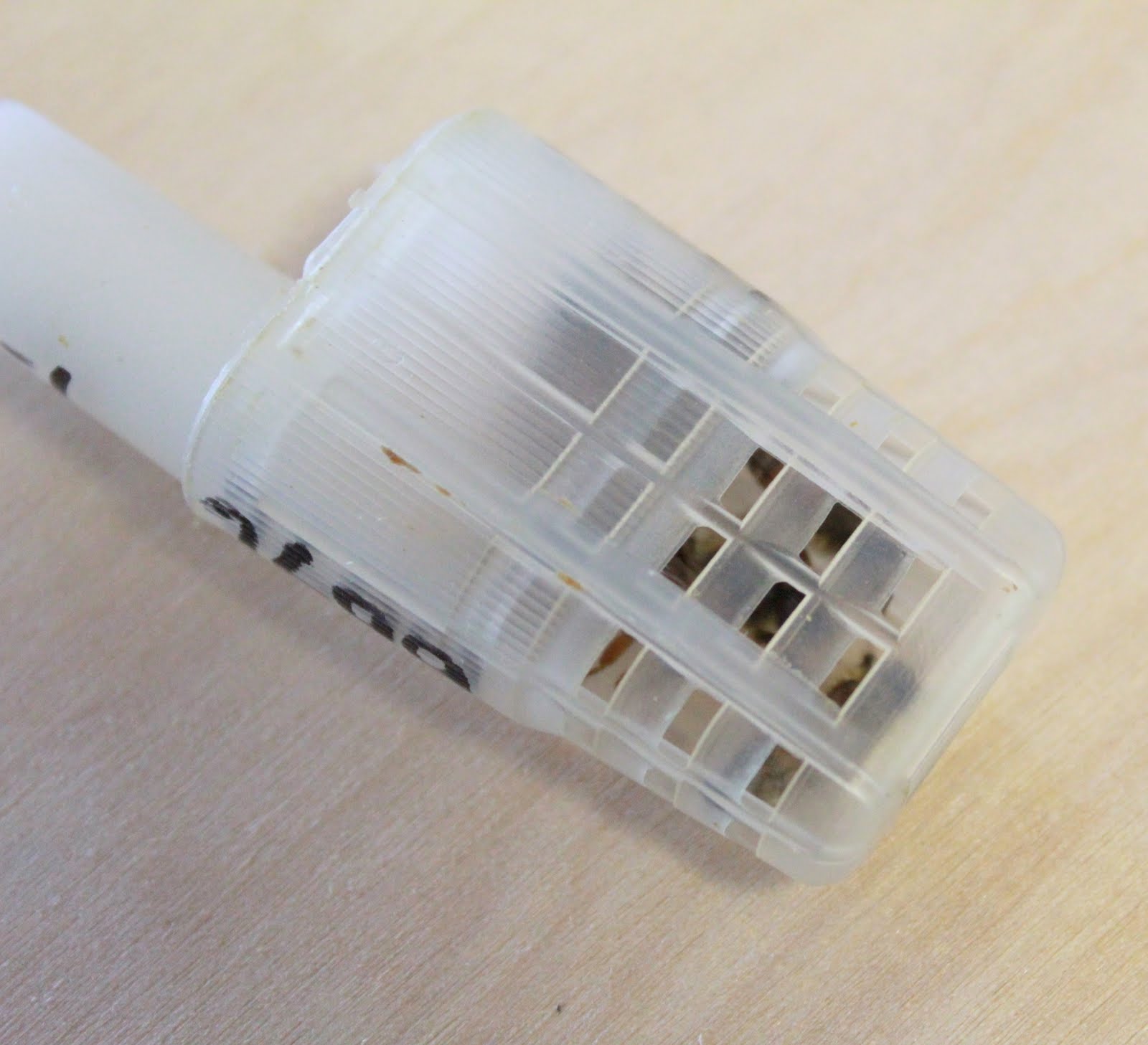 This container was inside the UPS mailer...so I opened it on up to check and make sure everyone arrived safely and unharmed. The while tube coming out of the top of the cage is full of soft candy. This way the bees from the new colony can eat through the candy to release the queen slowly into the hive.
Here she is in the hive getting to know her new colony. 

Monday, August 15, 2011
Hive Inspection
 Taking a look at the busy busy bees! The bees are doing great and are pretty much the only thing still thriving throughout the terrible heat we just experienced!
 I love seeing the new wax they are forming in an impressive amount of time, as well as the fresh capped honey!!


Monday, July 4, 2011
First Taste of our Capped Honey

 While Bryan was inspecting his bee hives, he pulled out a few honey bars and let us all have a taste. Freshly capped nectar does not taste like honey that you will find in the store. It has the same texture as the honey we all know, it slightly tart but very fresh and smooth. The bees cap the cell and over time it will become sweet honey. Putting the tip of your finger into the capped cells will bring out this delightful little treat!
Extremely fresh and local honey!


Preparing Top Bars for Bee hive
 First you need to collect all your boards. They can be anywhere from 1 3/8" to 1 3/4" depending on the bees. We purchased 8 foot 1x2 boards to cut down (which are 1 1/2"). Cut the boards to the top size of your bee box.
  Pull your cotton string tight across the center of your board and clamp each end so the string stays in place while you apply the wax line.
 At this point you are ready to melt the wax onto your cotton string line. We have tried several methods to get a good even wax line and the best and quickest method is to use a blow torch on low.

 Clip off the end of the string, toss the board into the pile, and start the next one!
 The top bars will all lay side by side on top of your bee box (wax side down).
Within a matter of days your bees will start building their own comb and storing up honey!


Saturday, July 2, 2011
Kenyan Top Bar Hives... Why we chose this style of hive
 Kenyan Top Bar Bee Hive
- Inexpensive: The number one motivation was cost! You can build these completely out of scrap wood. They are designed and developed for third world countries where materials are scarce. You could easily drop close to $1,000 in equipment alone for a Langstroth or Warre type hive. So the Kenyan Top Bar appealed to us in that way. All of the materials to build these 3 hives cost us a mere $20...and we have plenty of spare wood to build more as well!!
- Little Treatment: You have a reduced dependence on chemicals to treat various mites and hive beetles.
- Health: The bees build their own comb and cells which allows them to be healthier and resist mites. The bees know better than we do and they sure do know how to build their own comb...so why not let them!
- Versatility in Design & Size: There is not one set design so you can design and be creative with the construction. There are hundreds of designs out there for how each person prefers their top bar hive to look. Bryan designed and built our hives out of scrap wood which he bought at an estate sale. For $20 he purchased enough old scrap wood to make at least 10 hives (which we don't need 10 hives, but for $20 he decided to buy all the wood!). You can truly personalize these boxes! Bryan designed all of our hives to the same interior dimensions so that comb is transferable in case you want to split a colony.
There are many benefits and desirable features to the Kenyan Top Bar hive and this is just the surface! Join us on our journey as we discover and research more about this method of bee keeping.
Subscribe to:
Posts (Atom)